
Hard water is a problem present in most Polish homes
Over 70% of households in Poland have hard or very hard water. This means water rich in calcium and magnesium ions, which precipitate as scale when heated. This scale, in turn, builds up inside pipes, on appliance heating elements, in fixtures, on tiles, and on plumbing fixtures.
Although limescale initially appears to be merely an aesthetic nuisance, it actually causes much more serious problems:
The costs associated with hard water accumulate gradually. At a certain point, they are much higher than investing in a water softener, which eliminates the problem at the source.
Why is it worth planning a water softener during the renovation phase?
The best time to install a water softener is during the planning or implementation phase of the renovation. This is for several reasons.
1. Simplicity and aesthetics
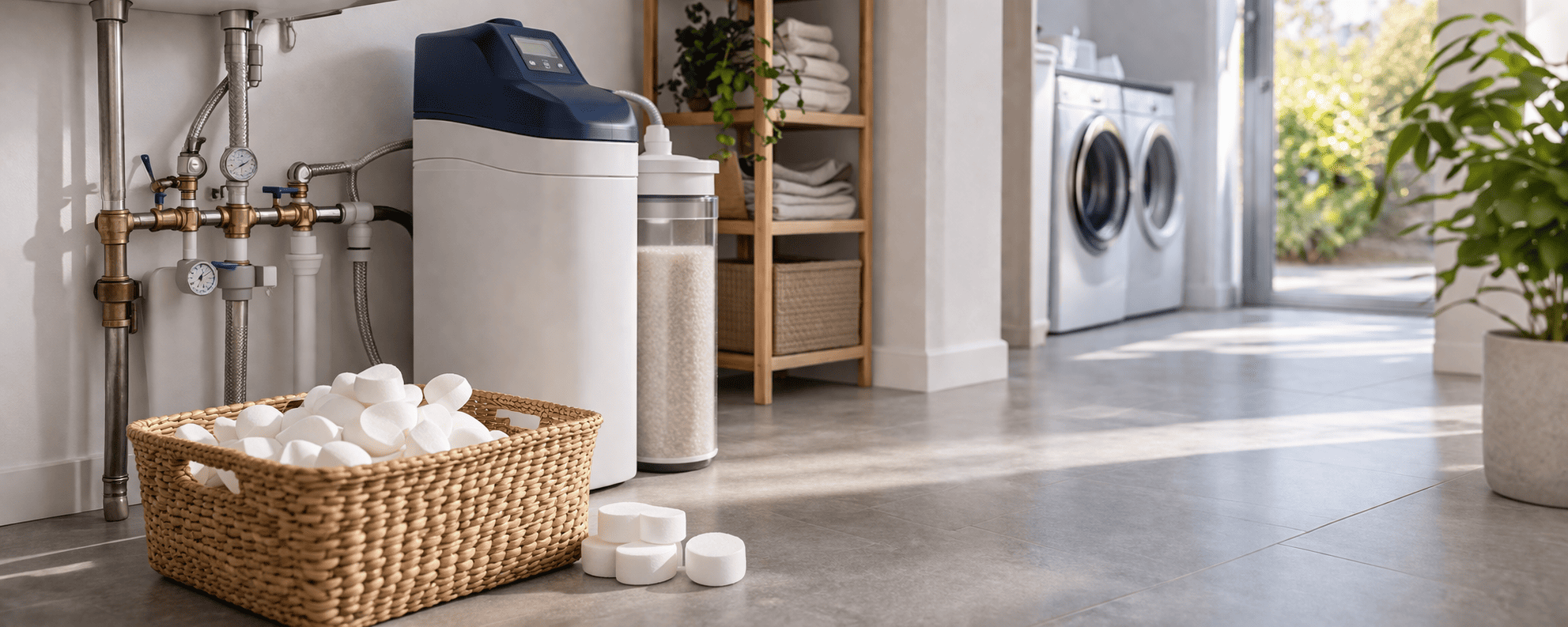
For a water softener to function properly, it requires a suitable location, access to water connections, and drainage. If this is taken into account during the renovation phase, installation is quick and does not require any intervention in finished rooms. In the case of a prefabricated house, installation often requires:
Planning ahead eliminates these problems.
2. Lower investment costs
Labor costs during renovations are significantly lower than later modifications. A plumber makes the connections immediately, and installing the device does not require additional materials or difficult interventions in the existing system.
3. System protection from the very beginning
If a water softener is installed during the finishing process, the entire system—from pipes to appliances—is protected from scale from the very beginning. This prevents gradual scale buildup, which becomes increasingly difficult to remove over time.
How does a water softener affect home plumbing and appliances?
Soft water changes the way your entire home functions. It protects:
Pipes and fittings - no scale buildup means stable flow and reduced susceptibility to failure.
Boilers, heat pumps, water heaters – softened water maintains the high efficiency of heating appliances.
Appliances – washing machines, dishwashers, and coffee machines - last longer and require less frequent descaling.
Finishing elements - faucets, shower enclosures, and tiles - remain shiny without persistent deposits.
The savings resulting from using softened water are noticeable in the household budget. Detergent consumption is reduced by up to half, and water heating costs can be reduced by several percent.
The key role of salt tablets – a small detail with a big impact
For a water softener to function effectively, it is necessary to regularly regenerate the ion exchange bed with salt. The best and most convenient form is salt tablets – highly purified, uniform, and free of contaminants.
Their use guarantees:
It's the only consumable part of a water softener — inexpensive, easy to refill, and crucial to the long-term operation of the entire system.
Water Softener – An Investment with the Highest Return
Although a water softener is a small device, its impact on your home is enormous. It protects the system, improves equipment efficiency, reduces maintenance costs, and significantly improves the comfort of water use. It's a solution that works daily, though it often remains invisible.
Therefore, it's worth planning its installation early—during the design or renovation phase. It's a long-term investment that will pay for itself sooner than most people expect.